

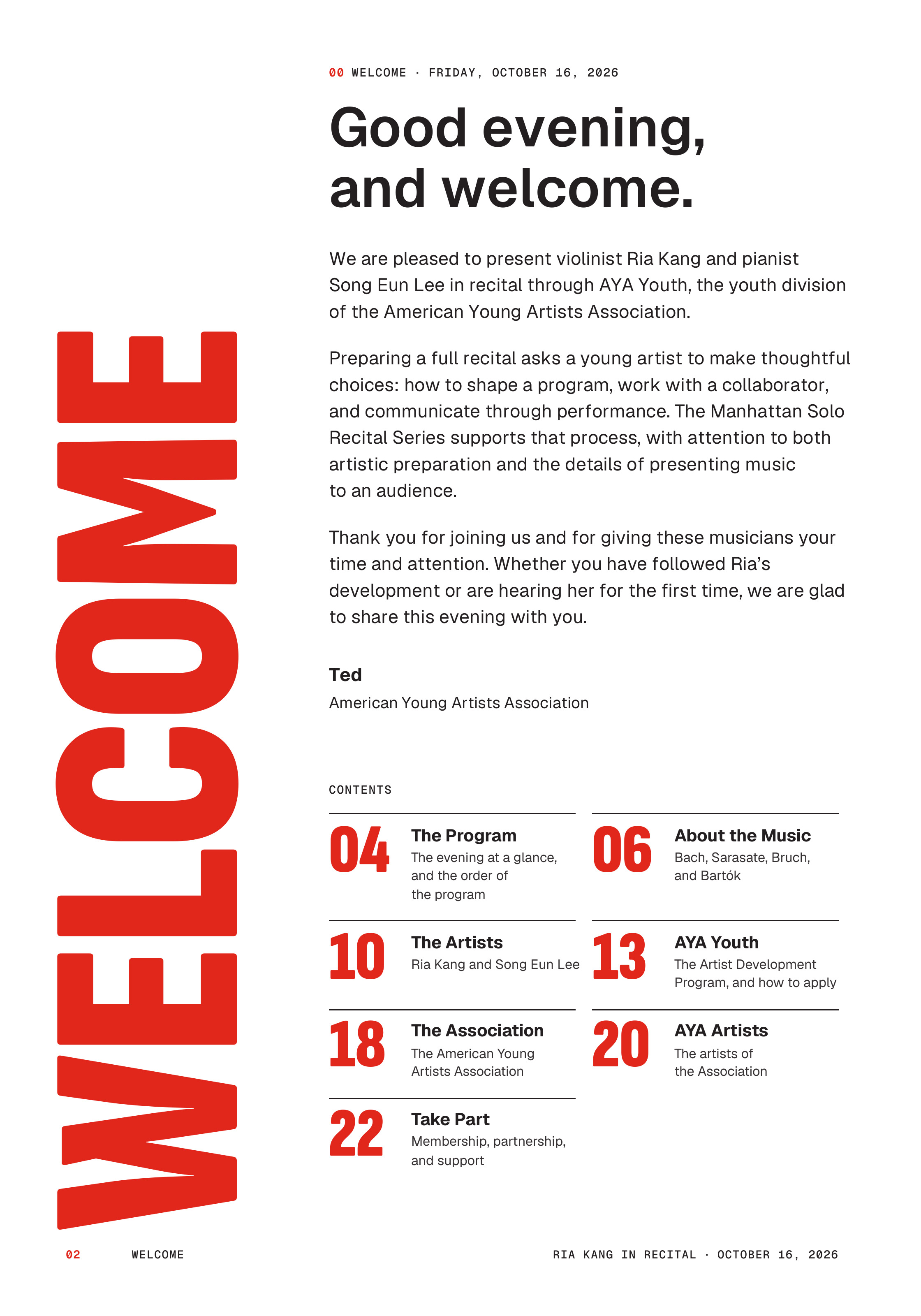
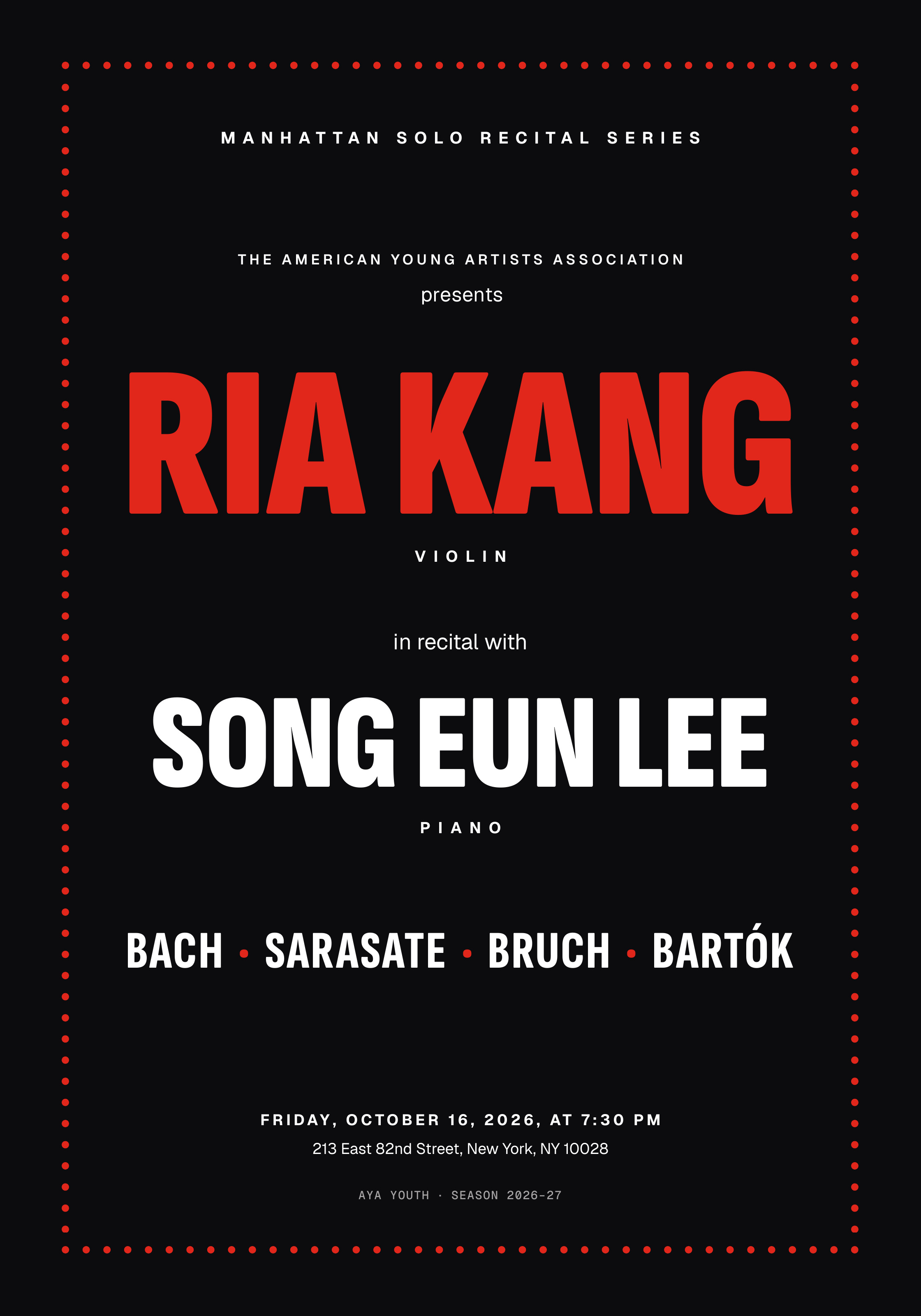
Manhattan Solo Recital Series · AYA Youth
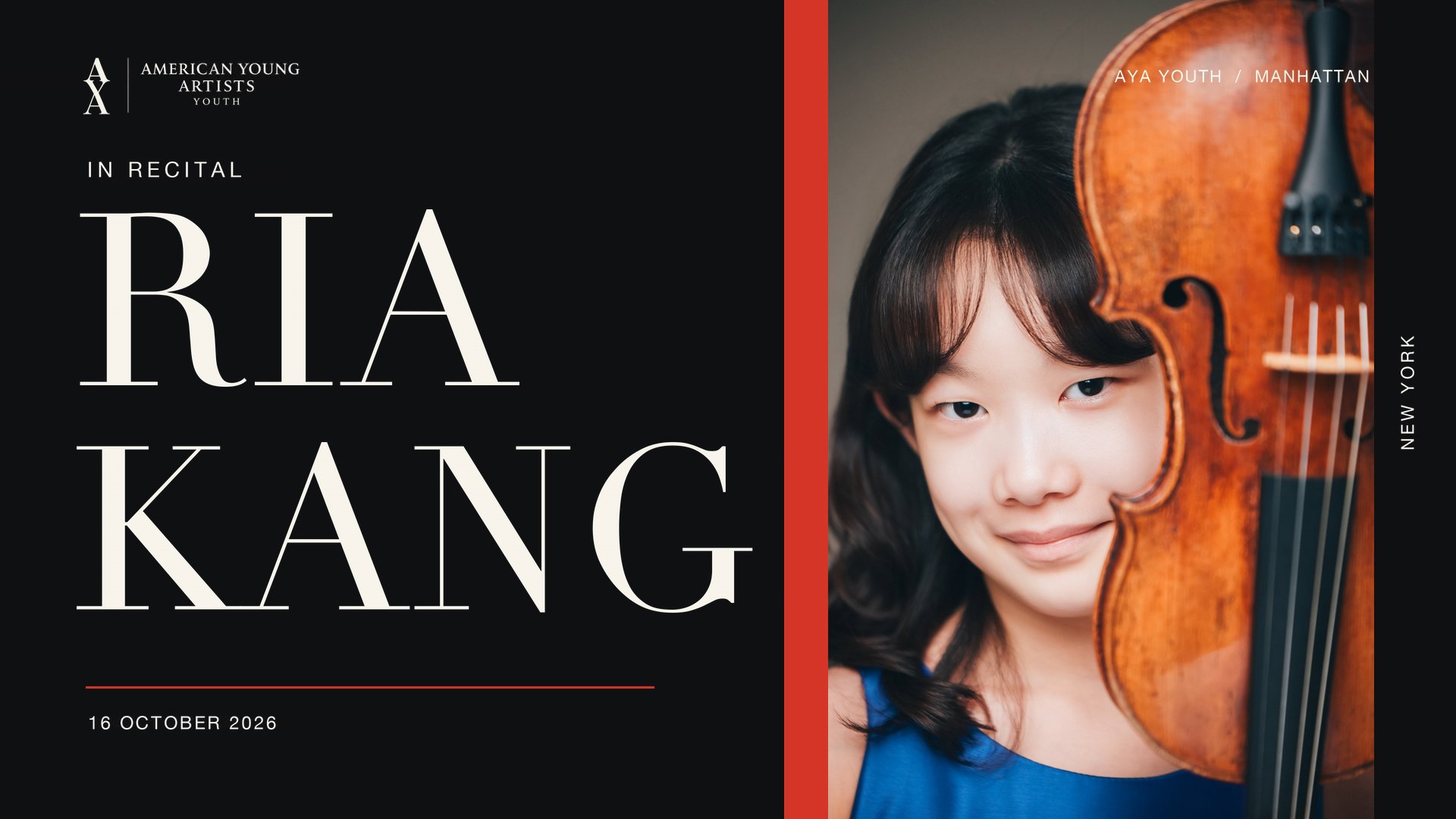
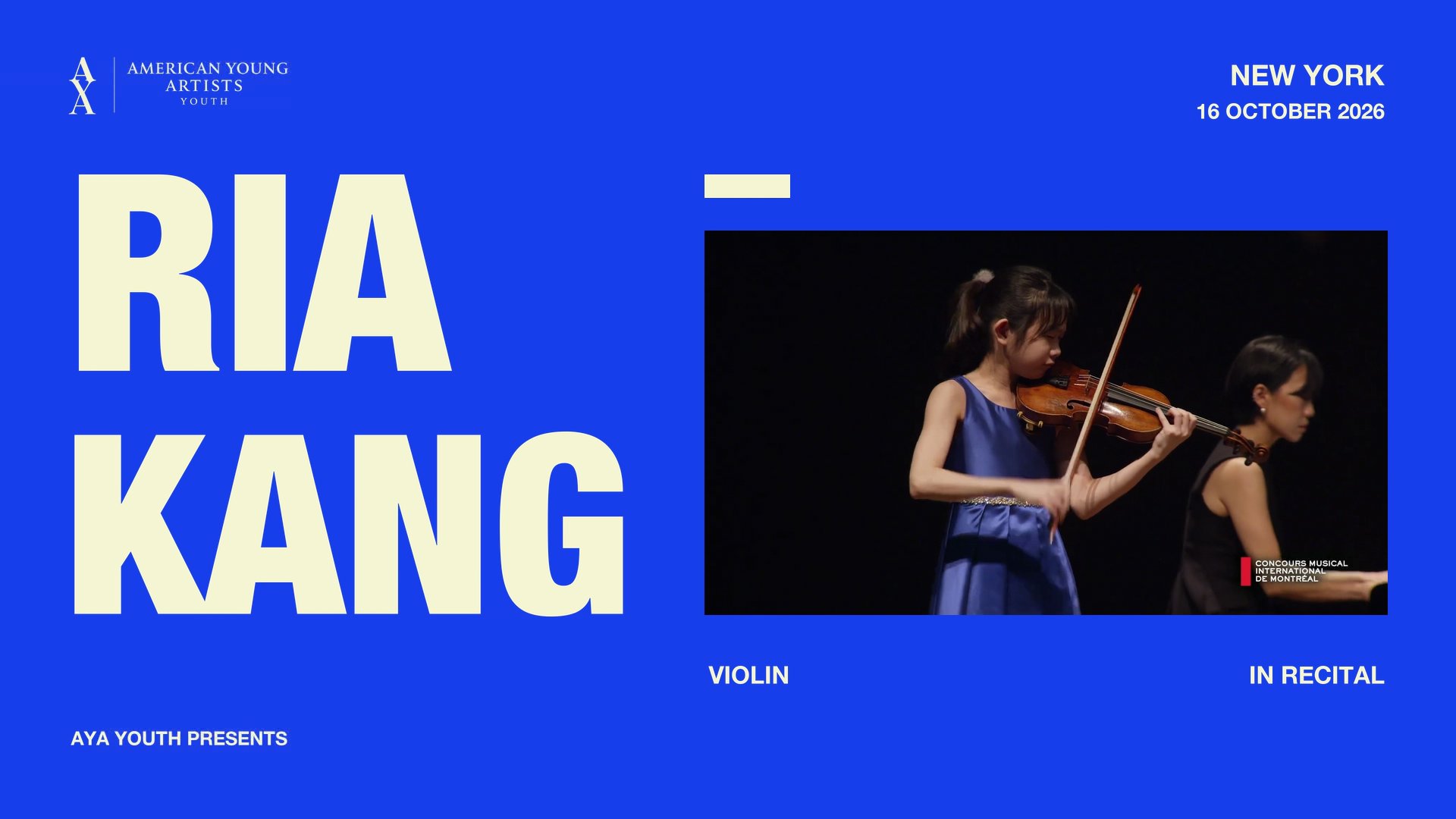
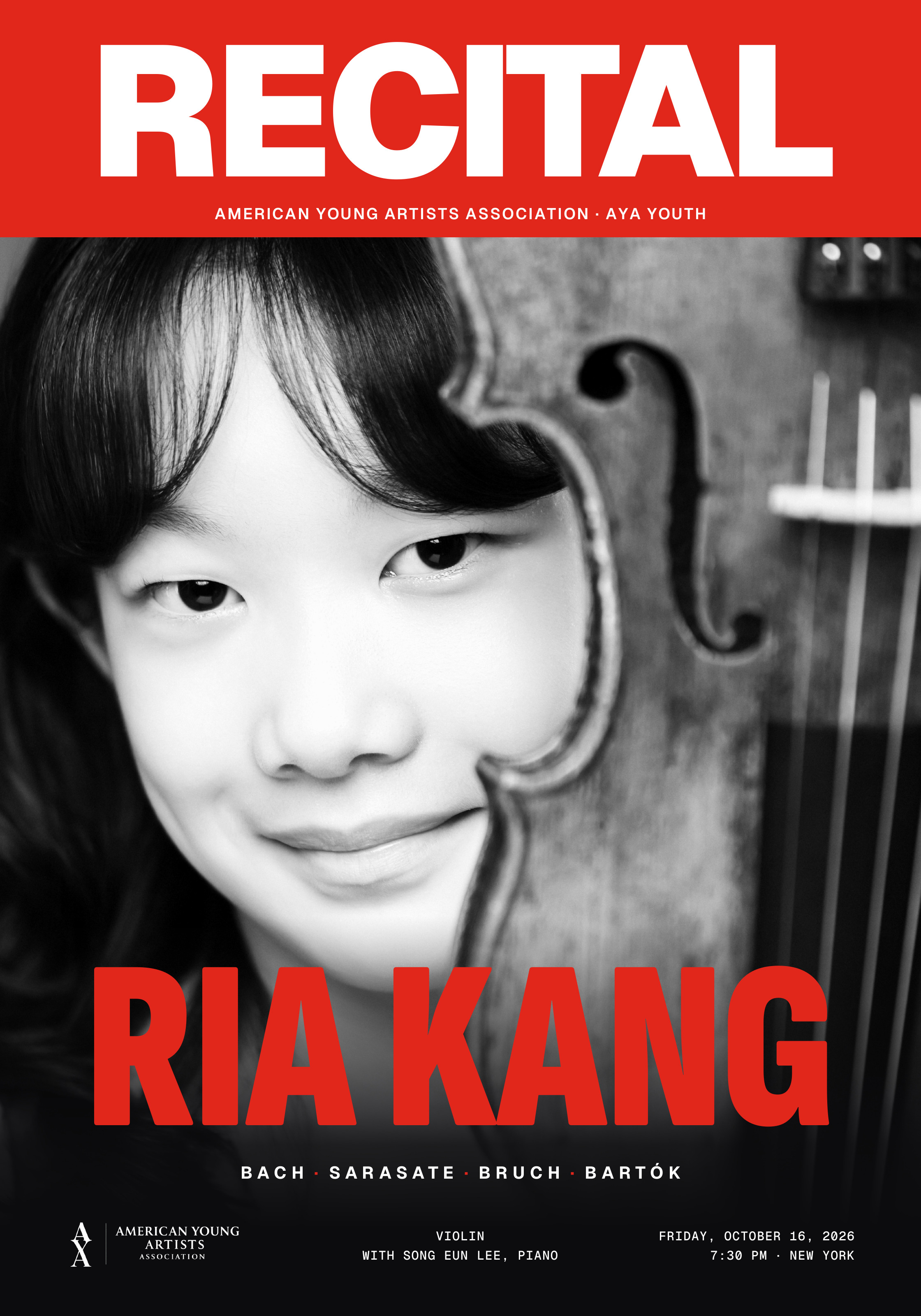
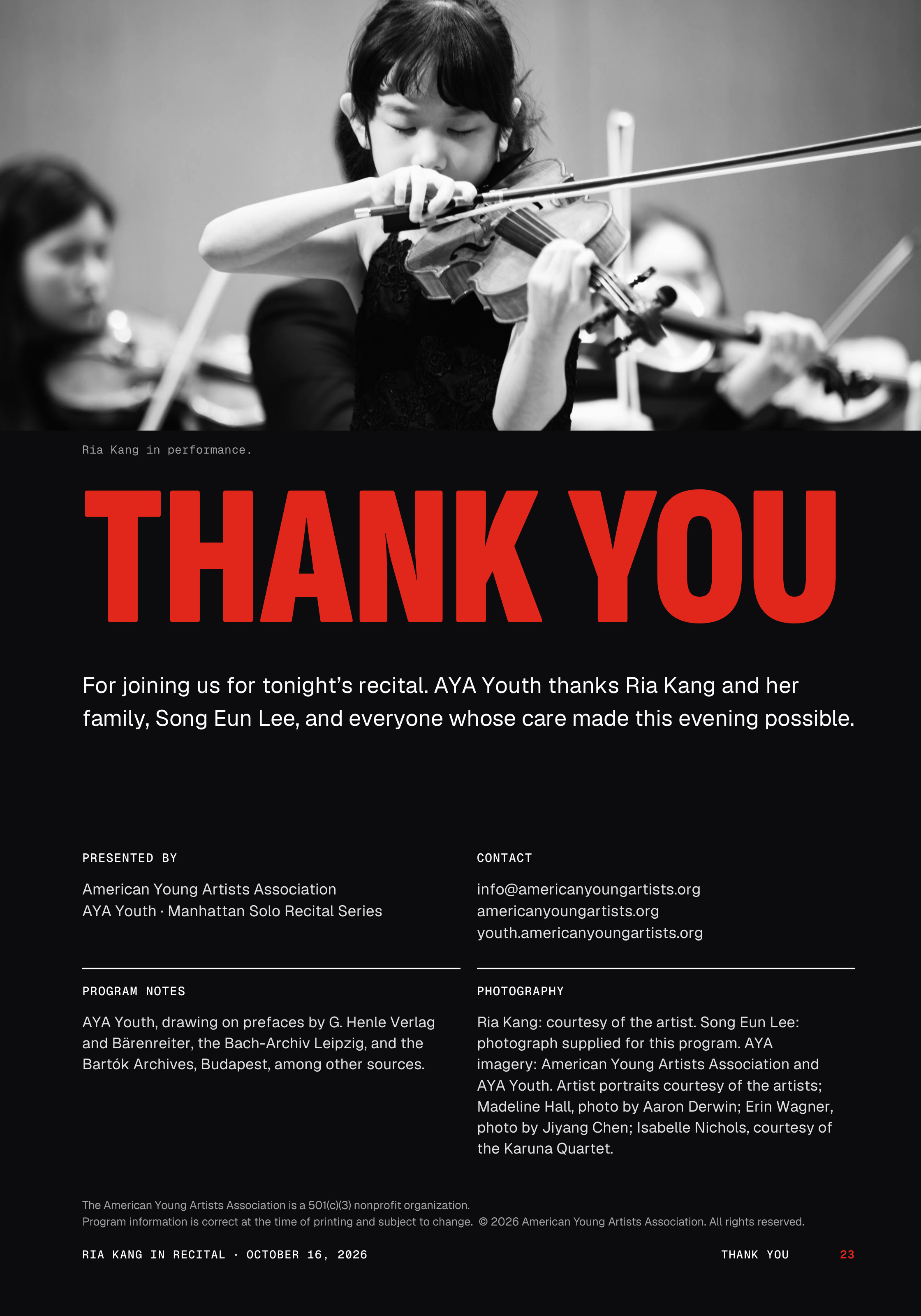
Ria Kang in Recital
Ria Kang, violin · Song Eun Lee, piano
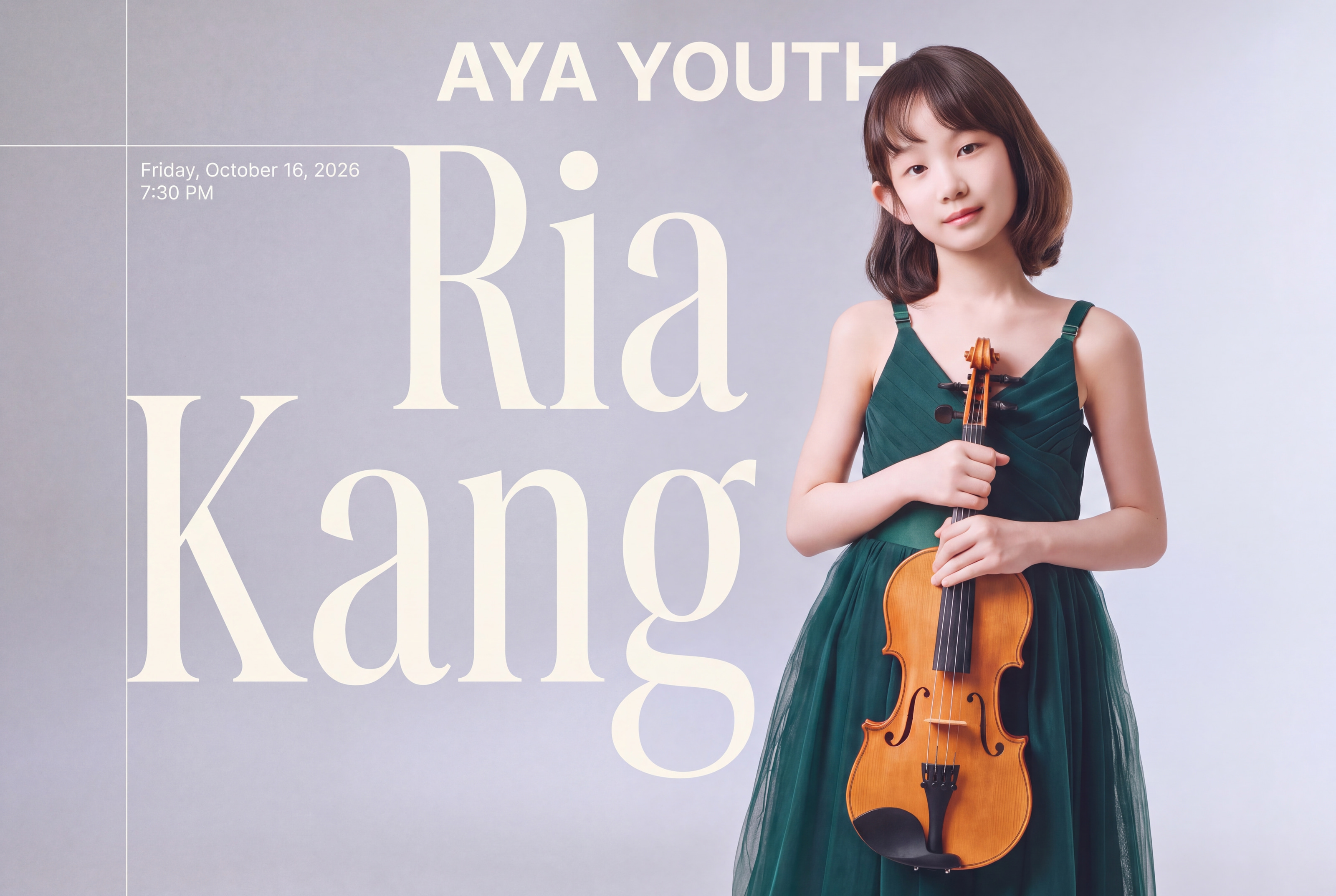
Friday, October 16, 2026 · 7:30 PM
213 East 82nd Street, New York, NY 10028
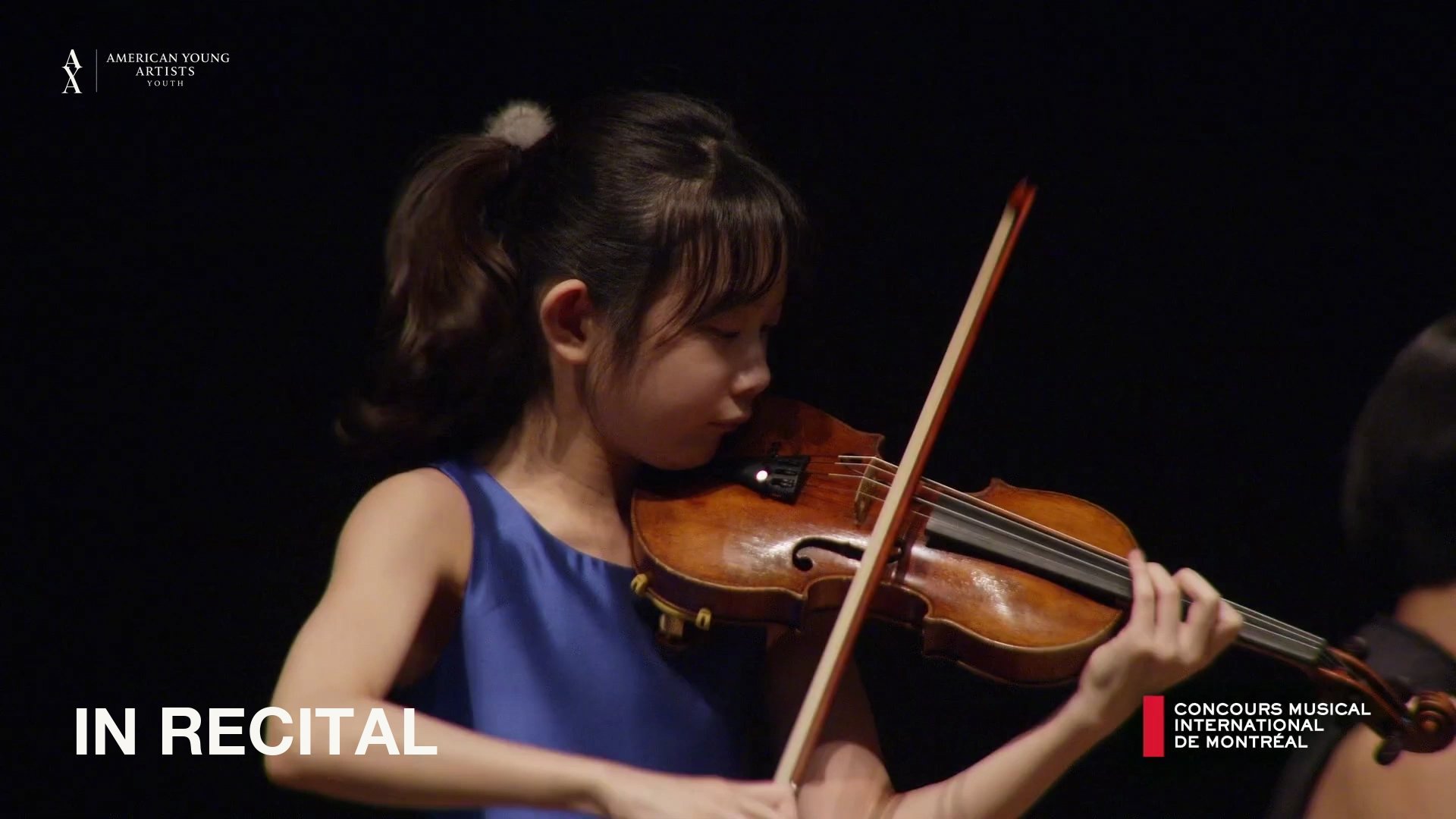
The American Young Artists Association presented violinist Ria Kang in recital with pianist Song Eun Lee, in a program of Bach, Sarasate, Bruch and Bartók.
The recital was part of the Manhattan Solo Recital Series of AYA Youth, the Association’s youth division.
Videos
Concert Program




Program
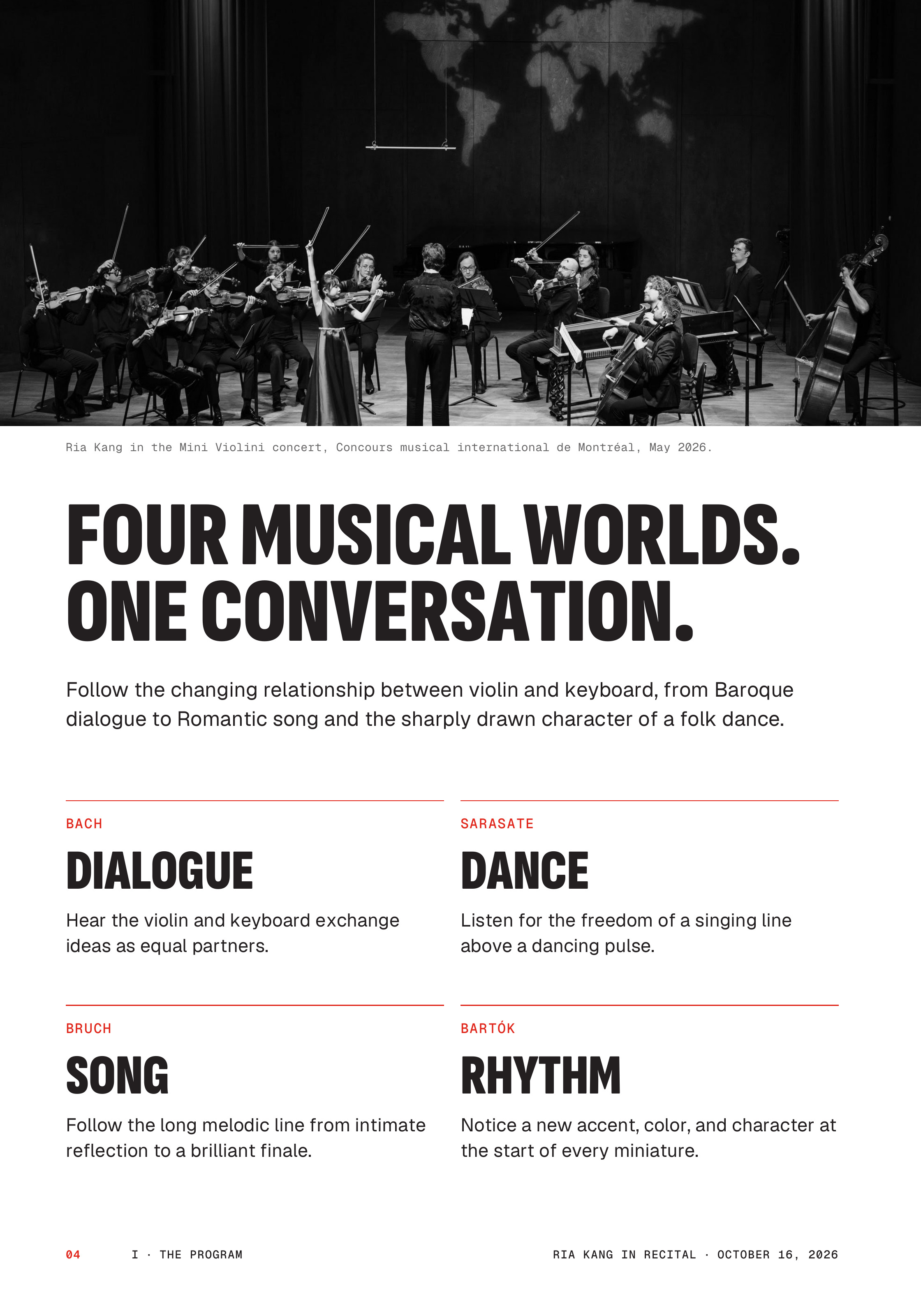
Four musical worlds. One conversation.
Follow the changing relationship between violin and keyboard, from Baroque dialogue to Romantic song and the sharply drawn character of a folk dance.
Bach
Dialogue
Hear the violin and keyboard exchange ideas as equal partners.
Sarasate
Dance
Listen for the freedom of a singing line above a dancing pulse.
Bruch
Song
Follow the long melodic line from intimate reflection to a brilliant finale.
Bartók
Rhythm
Notice a new accent, color, and character at the start of every miniature.
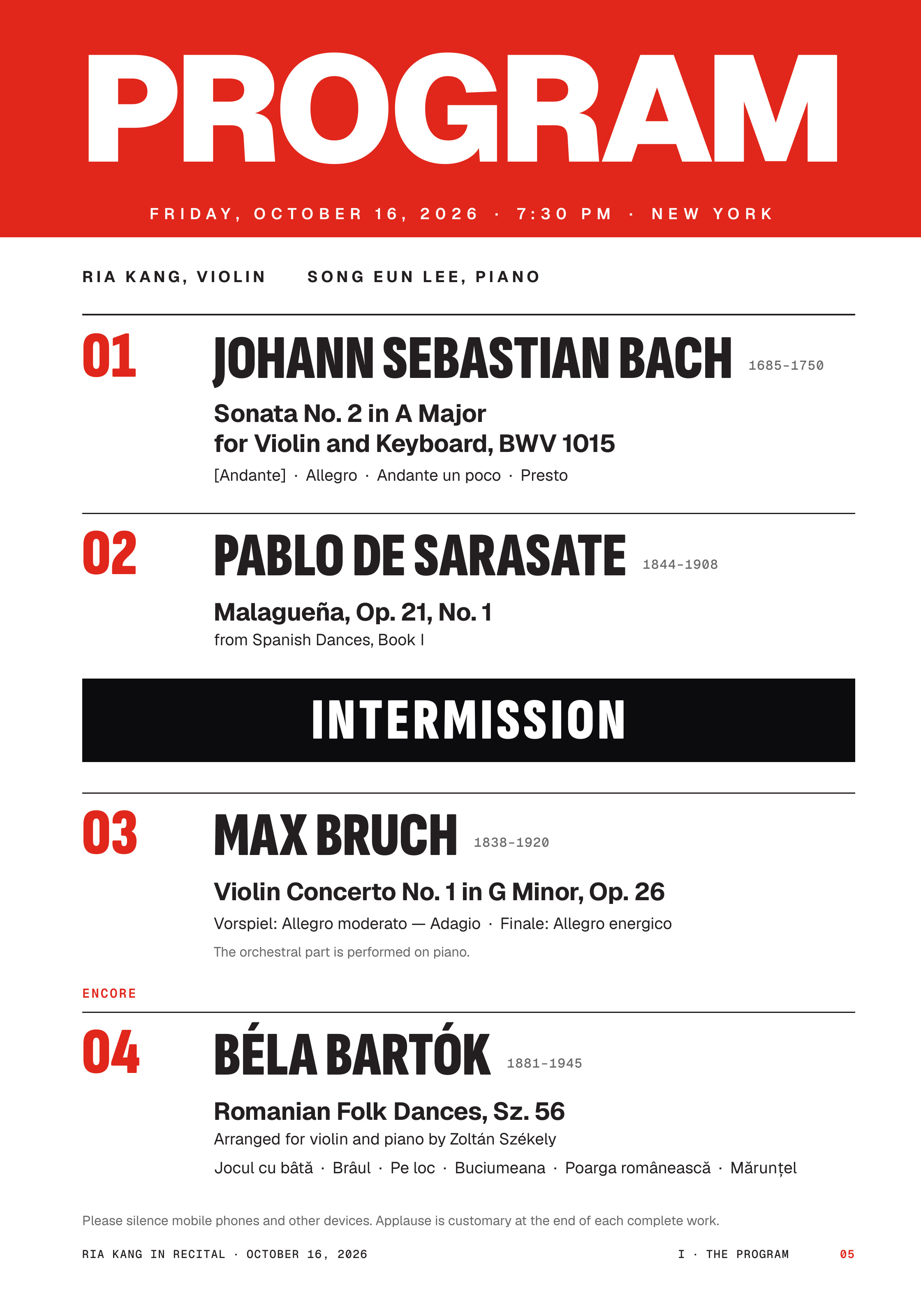
- 01
Johann Sebastian Bach
Sonata No. 2 in A Major for Violin and Keyboard, BWV 1015
[Andante] · Allegro · Andante un poco · Presto
1685–1750
- 02
Pablo de Sarasate
Malagueña, Op. 21, No. 1
from Spanish Dances, Book I
1844–1908
Intermission
- 03
Max Bruch
Violin Concerto No. 1 in G Minor, Op. 26
Vorspiel: Allegro moderato — Adagio · Finale: Allegro energico
The orchestral part is performed on piano.
1838–1920
Encore
- 04
Béla Bartók
Romanian Folk Dances, Sz. 56
Arranged for violin and piano by Zoltán Székely
Jocul cu bâtă · Brâul · Pe loc · Buciumeana · Poarga românească · Mărunțel
1881–1945
About the music
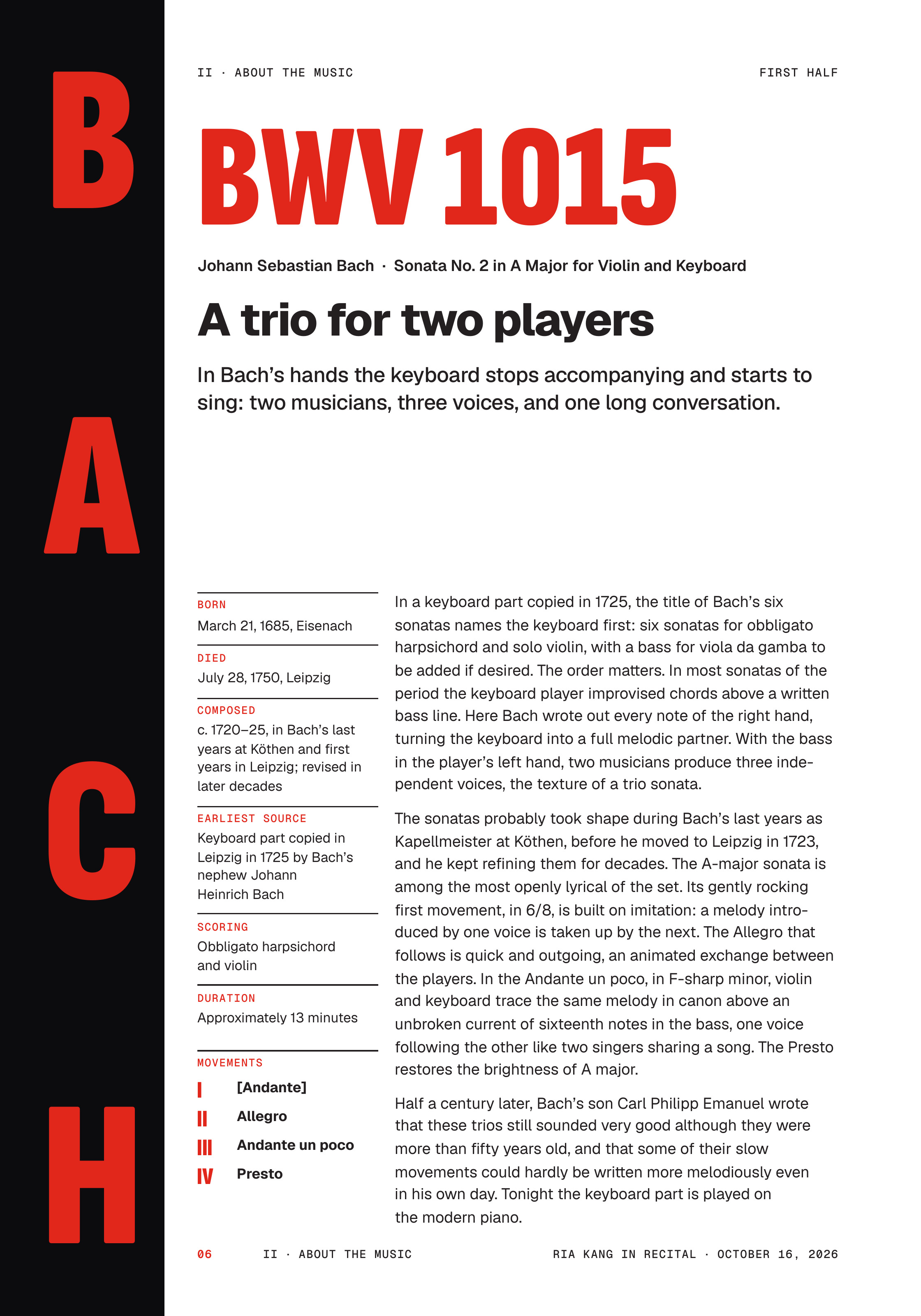
First halfBWV 1015
Johann Sebastian Bach · Sonata No. 2 in A Major for Violin and Keyboard
A trio for two players
In Bach’s hands the keyboard stops accompanying and starts to sing: two musicians, three voices, and one long conversation.
- Born
- March 21, 1685, Eisenach
- Died
- July 28, 1750, Leipzig
- Composed
- c. 1720–25, in Bach’s last years at Köthen and first years in Leipzig; revised in later decades
- Earliest source
- Keyboard part copied in Leipzig in 1725 by Bach’s nephew Johann Heinrich Bach
- Scoring
- Obbligato harpsichord and violin
- Duration
- Approximately 13 minutes
- Movements
- I[Andante]
- IIAllegro
- IIIAndante un poco
- IVPresto
In a keyboard part copied in 1725, the title of Bach’s six sonatas names the keyboard first: six sonatas for obbligato harpsichord and solo violin, with a bass for viola da gamba to be added if desired. The order matters. In most sonatas of the period the keyboard player improvised chords above a written bass line. Here Bach wrote out every note of the right hand, turning the keyboard into a full melodic partner. With the bass in the player’s left hand, two musicians produce three independent voices, the texture of a trio sonata.
The sonatas probably took shape during Bach’s last years as Kapellmeister at Köthen, before he moved to Leipzig in 1723, and he kept refining them for decades. The A-major sonata is among the most openly lyrical of the set. Its gently rocking first movement, in 6/8, is built on imitation: a melody introduced by one voice is taken up by the next. The Allegro that follows is quick and outgoing, an animated exchange between the players. In the Andante un poco, in F-sharp minor, violin and keyboard trace the same melody in canon above an unbroken current of sixteenth notes in the bass, one voice following the other like two singers sharing a song. The Presto restores the brightness of A major.
Half a century later, Bach’s son Carl Philipp Emanuel wrote that these trios still sounded very good although they were more than fifty years old, and that some of their slow movements could hardly be written more melodiously even in his own day. In this recital the keyboard part is played on the modern piano.
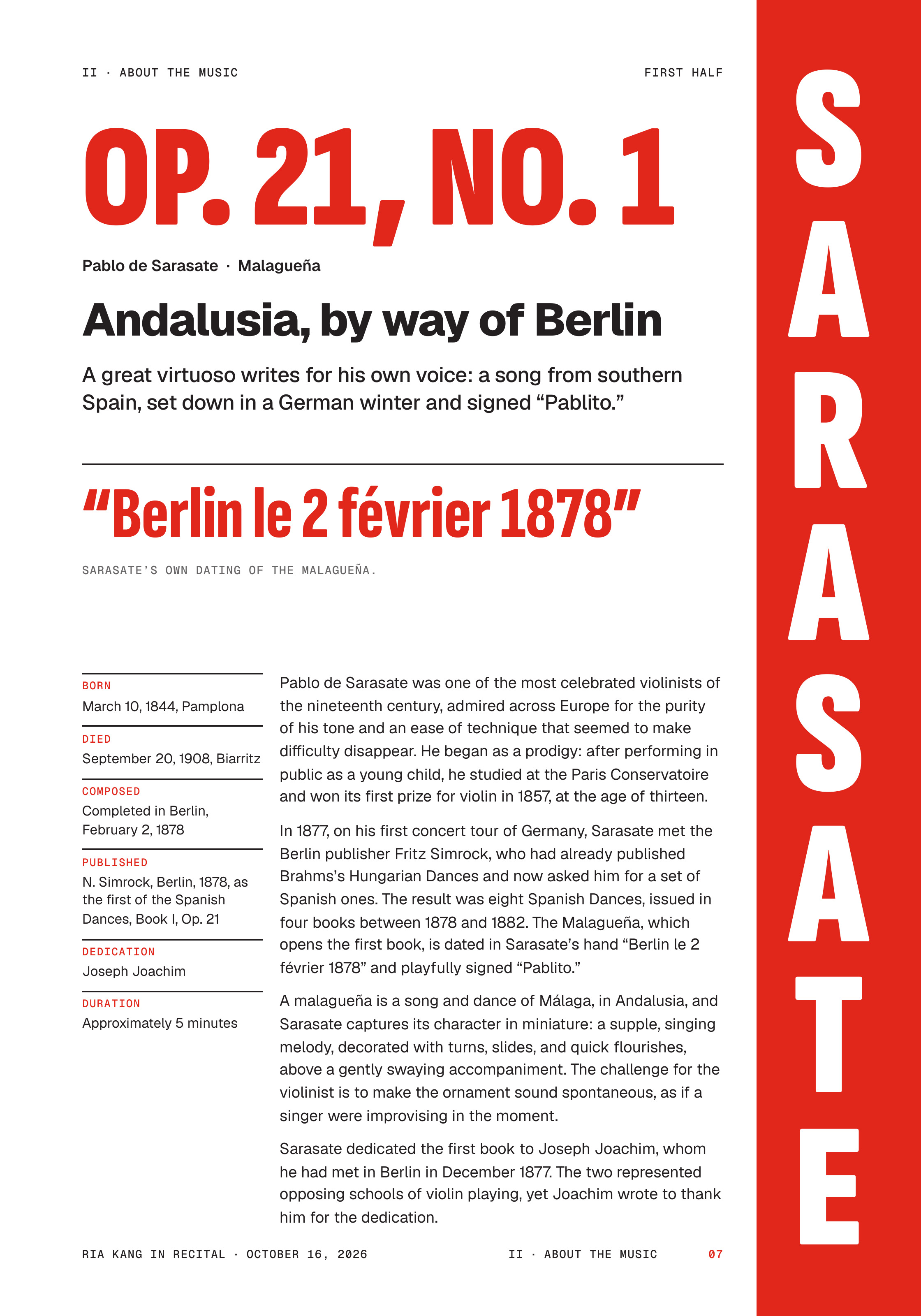
First halfOp. 21, No. 1
Pablo de Sarasate · Malagueña
Andalusia, by way of Berlin
A great virtuoso writes for his own voice: a song from southern Spain, set down in a German winter and signed “Pablito.”
- Born
- March 10, 1844, Pamplona
- Died
- September 20, 1908, Biarritz
- Composed
- Completed in Berlin, February 2, 1878
- Published
- N. Simrock, Berlin, 1878, as the first of the Spanish Dances, Book I, Op. 21
- Dedication
- Joseph Joachim
- Duration
- Approximately 5 minutes
“Berlin le 2 février 1878”
Pablo de Sarasate was one of the most celebrated violinists of the nineteenth century, admired across Europe for the purity of his tone and an ease of technique that seemed to make difficulty disappear. He began as a prodigy: after performing in public as a young child, he studied at the Paris Conservatoire and won its first prize for violin in 1857, at the age of thirteen.
In 1877, on his first concert tour of Germany, Sarasate met the Berlin publisher Fritz Simrock, who had already published Brahms’s Hungarian Dances and now asked him for a set of Spanish ones. The result was eight Spanish Dances, issued in four books between 1878 and 1882. The Malagueña, which opens the first book, is dated in Sarasate’s hand “Berlin le 2 février 1878” and playfully signed “Pablito.”
A malagueña is a song and dance of Málaga, in Andalusia, and Sarasate captures its character in miniature: a supple, singing melody, decorated with turns, slides, and quick flourishes, above a gently swaying accompaniment. The challenge for the violinist is to make the ornament sound spontaneous, as if a singer were improvising in the moment.
Sarasate dedicated the first book to Joseph Joachim, whom he had met in Berlin in December 1877. The two represented opposing schools of violin playing, yet Joachim wrote to thank him for the dedication.
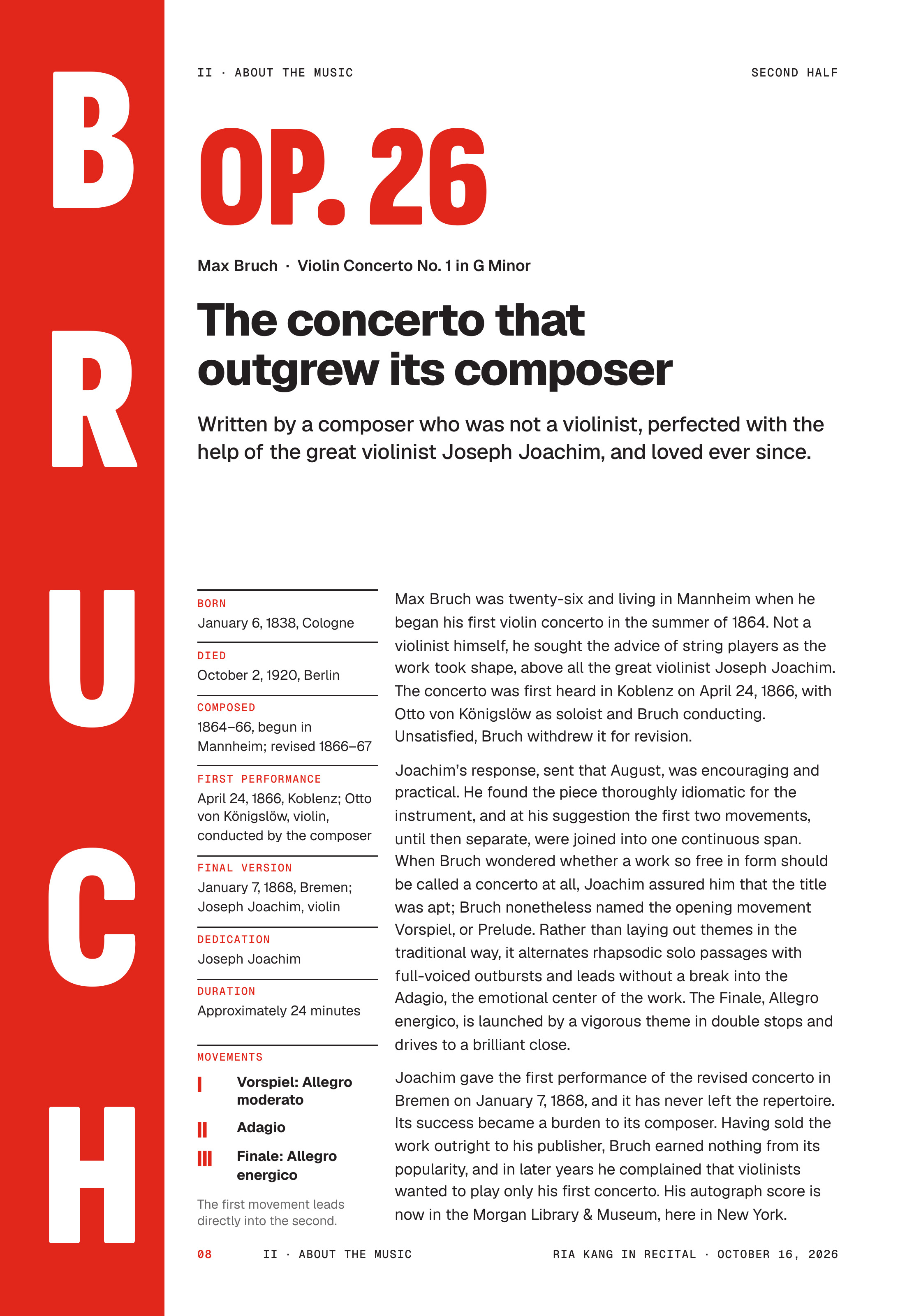
Second halfOp. 26
Max Bruch · Violin Concerto No. 1 in G Minor
The concerto that outgrew its composer
Written by a composer who was not a violinist, perfected with the help of the great violinist Joseph Joachim, and loved ever since.
- Born
- January 6, 1838, Cologne
- Died
- October 2, 1920, Berlin
- Composed
- 1864–66, begun in Mannheim; revised 1866–67
- First performance
- April 24, 1866, Koblenz; Otto von Königslöw, violin, conducted by the composer
- Final version
- January 7, 1868, Bremen; Joseph Joachim, violin
- Dedication
- Joseph Joachim
- Duration
- Approximately 24 minutes
- Movements
- IVorspiel: Allegro moderato
- IIAdagio
- IIIFinale: Allegro energico
The first movement leads directly into the second.
Max Bruch was twenty-six and living in Mannheim when he began his first violin concerto in the summer of 1864. Not a violinist himself, he sought the advice of string players as the work took shape, above all the great violinist Joseph Joachim. The concerto was first heard in Koblenz on April 24, 1866, with Otto von Königslöw as soloist and Bruch conducting. Unsatisfied, Bruch withdrew it for revision.
Joachim’s response, sent that August, was encouraging and practical. He found the piece thoroughly idiomatic for the instrument, and at his suggestion the first two movements, until then separate, were joined into one continuous span. When Bruch wondered whether a work so free in form should be called a concerto at all, Joachim assured him that the title was apt; Bruch nonetheless named the opening movement Vorspiel, or Prelude. Rather than laying out themes in the traditional way, it alternates rhapsodic solo passages with full-voiced outbursts and leads without a break into the Adagio, the emotional center of the work. The Finale, Allegro energico, is launched by a vigorous theme in double stops and drives to a brilliant close.
Joachim gave the first performance of the revised concerto in Bremen on January 7, 1868, and it has never left the repertoire. Its success became a burden to its composer. Having sold the work outright to his publisher, Bruch earned nothing from its popularity, and in later years he complained that violinists wanted to play only his first concerto. His autograph score is now in the Morgan Library & Museum, here in New York.
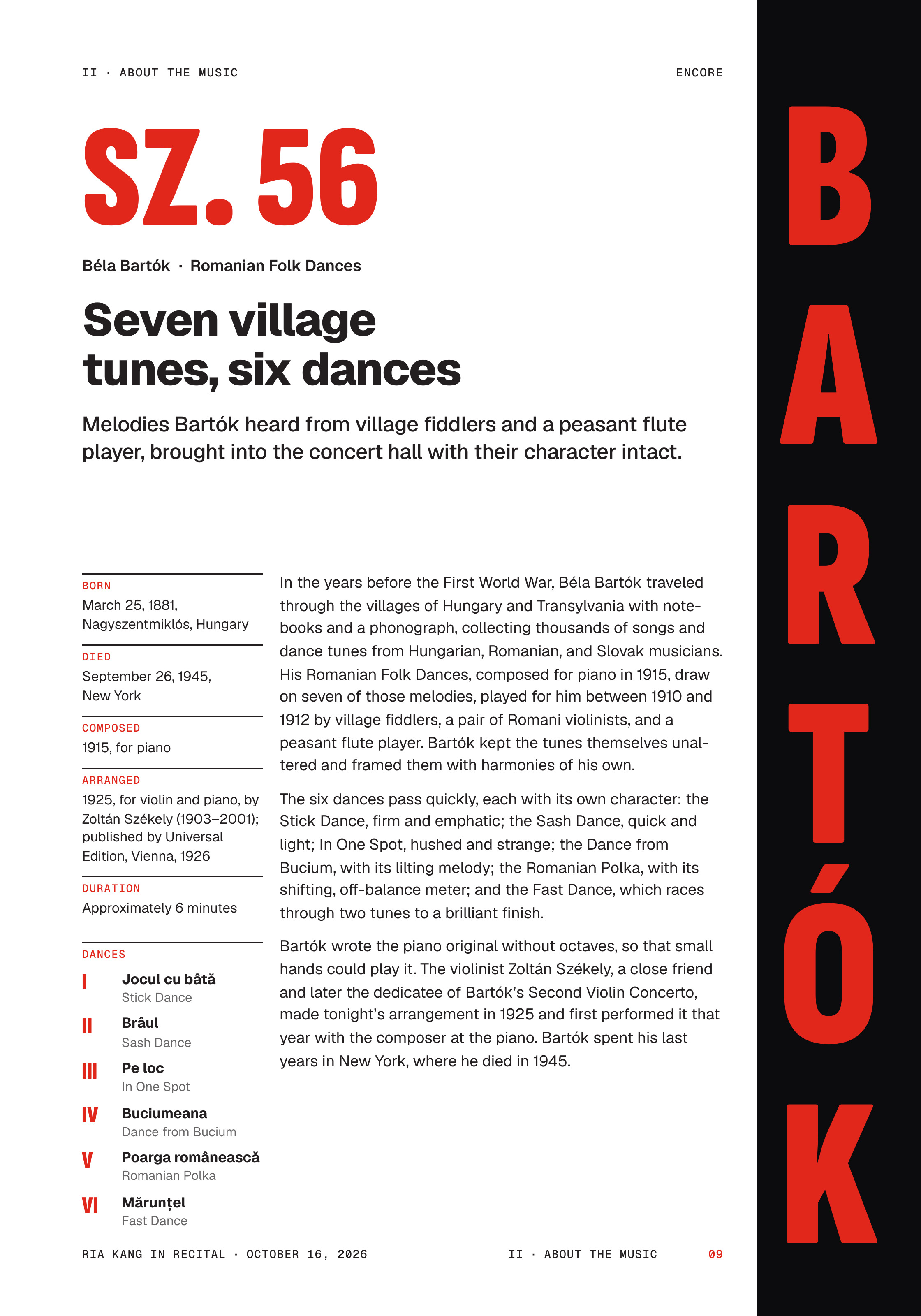
EncoreSz. 56
Béla Bartók · Romanian Folk Dances
Seven village tunes, six dances
Melodies Bartók heard from village fiddlers and a peasant flute player, brought into the concert hall with their character intact.
- Born
- March 25, 1881, Nagyszentmiklós, Hungary
- Died
- September 26, 1945, New York
- Composed
- 1915, for piano
- Arranged
- 1925, for violin and piano, by Zoltán Székely (1903–2001); published by Universal Edition, Vienna, 1926
- Duration
- Approximately 6 minutes
- Dances
- IJocul cu bâtăStick Dance
- IIBrâulSash Dance
- IIIPe locIn One Spot
- IVBuciumeanaDance from Bucium
- VPoarga româneascăRomanian Polka
- VIMărunțelFast Dance
In the years before the First World War, Béla Bartók traveled through the villages of Hungary and Transylvania with notebooks and a phonograph, collecting thousands of songs and dance tunes from Hungarian, Romanian, and Slovak musicians. His Romanian Folk Dances, composed for piano in 1915, draw on seven of those melodies, played for him between 1910 and 1912 by village fiddlers, a pair of Romani violinists, and a peasant flute player. Bartók kept the tunes themselves unaltered and framed them with harmonies of his own.
The six dances pass quickly, each with its own character: the Stick Dance, firm and emphatic; the Sash Dance, quick and light; In One Spot, hushed and strange; the Dance from Bucium, with its lilting melody; the Romanian Polka, with its shifting, off-balance meter; and the Fast Dance, which races through two tunes to a brilliant finish.
Bartók wrote the piano original without octaves, so that small hands could play it. The violinist Zoltán Székely, a close friend and later the dedicatee of Bartók’s Second Violin Concerto, made the arrangement heard in this recital in 1925 and first performed it that year with the composer at the piano. Bartók spent his last years in New York, where he died in 1945.
About the artist
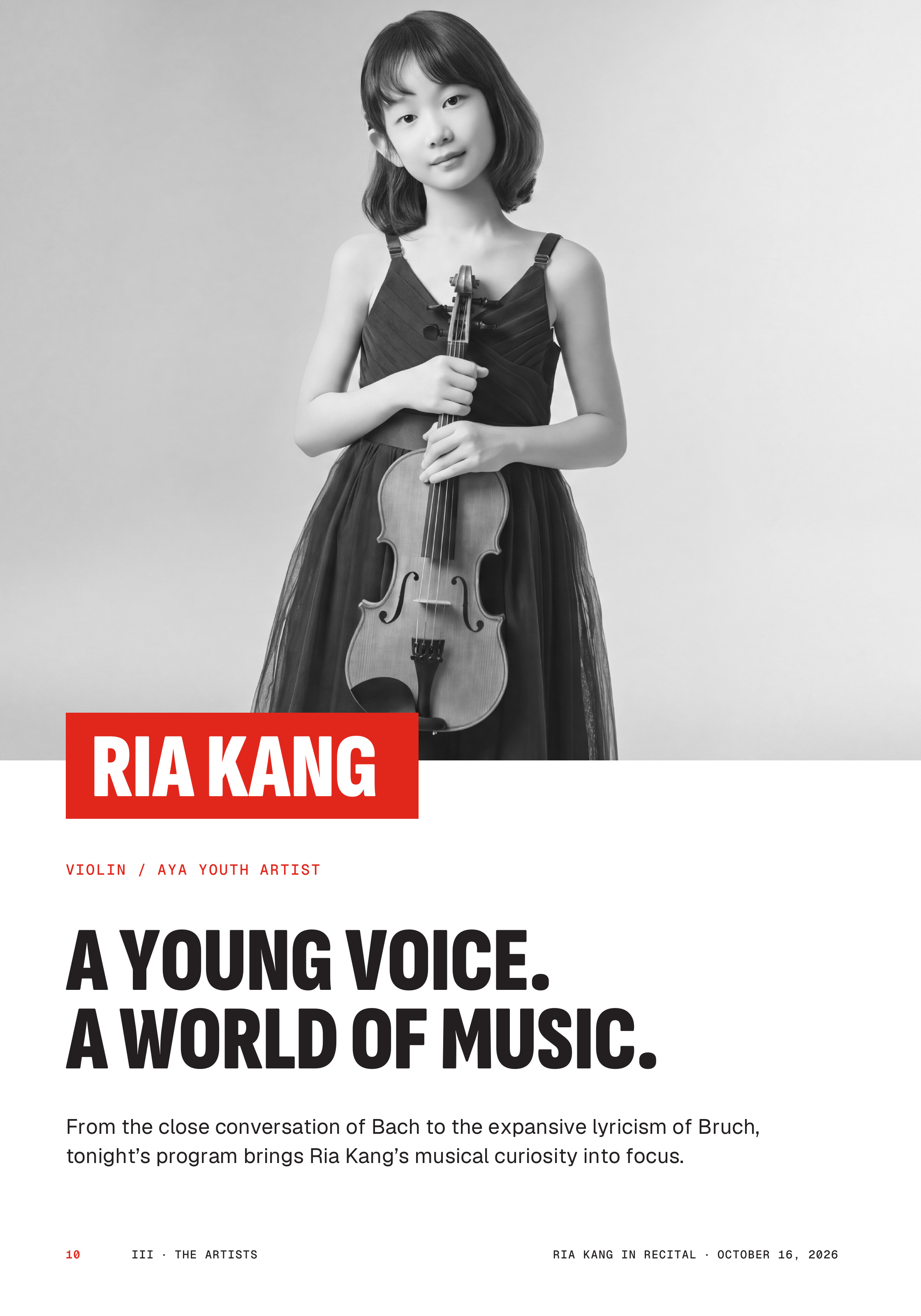
Ria Kang
- Violin
- AYA Youth Artist
- Juilliard Pre-College
- Student of Catherine Cho
A young voice. A world of music.
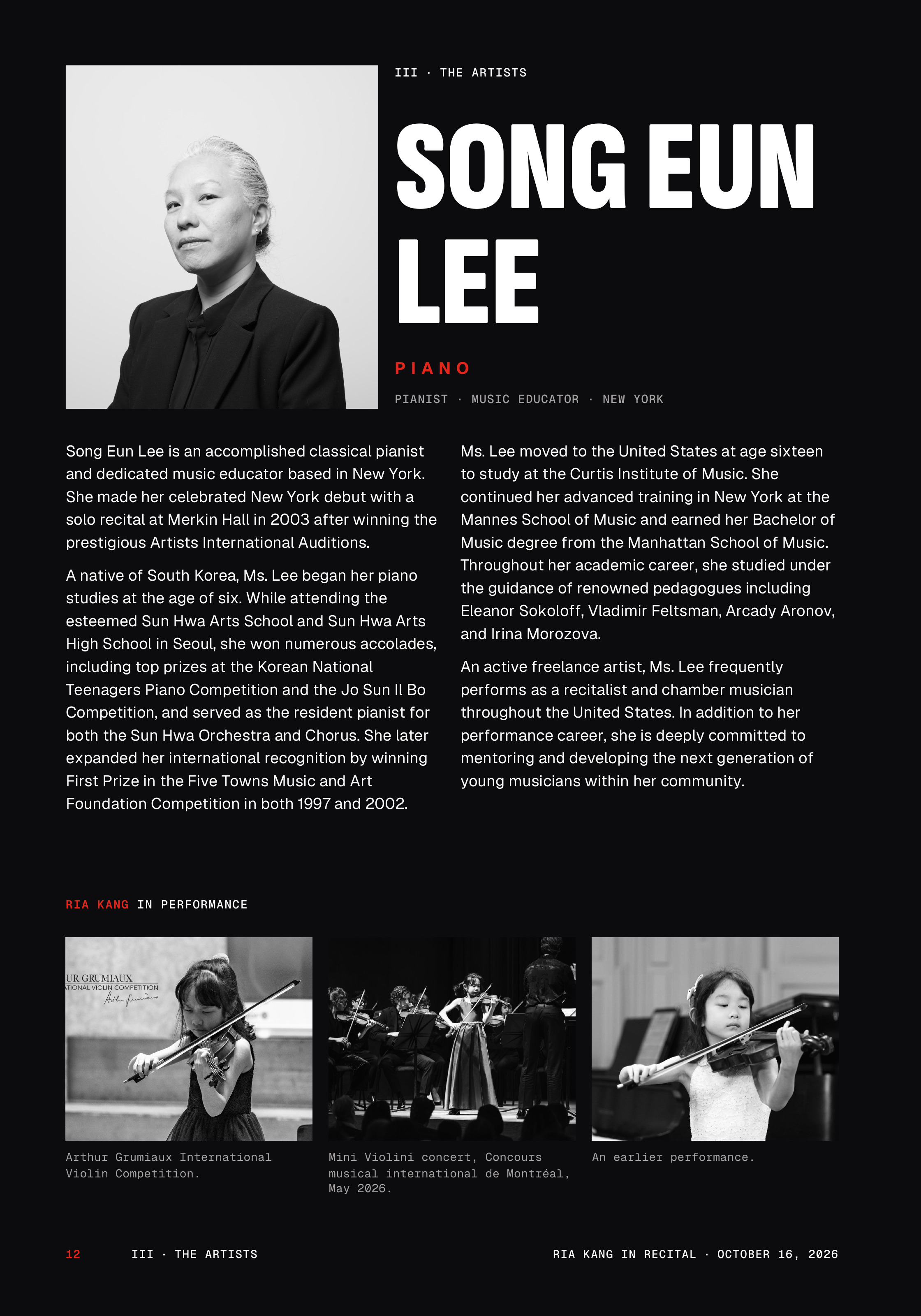
Violinist Ria Kang, an AYA Youth Artist, is known for her musical sensitivity, expressive subtlety, and commanding stage presence. She has performed at Carnegie Hall, Lincoln Center, and Merkin Hall. In May 2026 she appeared in the Concours musical international de Montréal’s Mini Violini concert as the youngest of four artists selected worldwide, and the previous month she performed at the opening ceremony of the World AI Film Festival in Cannes.
Ria won first prize in Category I of the 2024 Arthur Grumiaux International Violin Competition. She has also won first prizes at the Camerata Artists International Competition, the New York International Music Festival & Concours, the New York Young Virtuoso Competition, the Music International Grand Prix, and the Philadelphia International Music Festival Concerto Competition.
She began the violin at four, made her first Carnegie Hall appearance in Weill Recital Hall at six, and at seven was accepted into the Pre-College program of The Juilliard School, where she studies with Catherine Cho. She previously studied with Sheryl Staples, Joseph Lin, and Marvin Moon. She made her orchestral debut with the Seocho Philharmonia at nine.
Recent appearances include Juilliard’s Kayden Music Commissioning Program, where she took part in the world premiere of ten violin-duo versions of Curtis Stewart’s 24 American Caprices; the Steinway Spirio Ambassador Launch at Steinway Hall; and an annual investor conference at Jazz at Lincoln Center. In June 2025 she was the youngest of thirteen student artists selected for Juilliard’s Starling-DeLay Symposium on Violin Studies, performing in both a recital and a public masterclass. In 2024 she performed in the Juilliard Celebration concert at the Peter Jay Sharp Theater and appeared as a guest artist at the Youth America Grand Prix 25th Anniversary Gala at Lincoln Center’s David H. Koch Theater.
Ria has participated in the Tibor Varga Academy, Sounding Point Academy, Heifetz Institute, and Philadelphia International Music Festival, and has worked in lessons and masterclasses with Randall Goosby, Cornelia Heard, Pavel Vernikov, Svetlana Makarova, Bob Lipsett, Masao Kawasaki, Richard Lin, Xiao Wang, and Kimberly Fisher. Her playing has been featured by ABC7 New York, The Strad, SBS News, New Jersey Stage, and Violinist.com, and she has been recognized by the Republic of Korea’s Ministry of Patriots and Veterans Affairs Global Honors Club and the Bergen County Board of Commissioners.
Beyond music, Ria earned High Honors in the 2022–23 talent search of the Johns Hopkins Center for Talented Youth. She enjoys acting, reading, writing, drawing, and time with her Maltese, Milk.